Would you like to make this site your homepage? It's fast and easy...
Yes, Please make this my home page!
 |
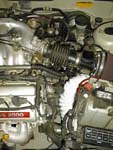 It occured to me the other day that I still had one intake resonator left on the car. This was the one that hangs down from the bottom of the pipe that connects the TB (throttle body) to the MAS (mass-air sensor). I started to wonder if I would get any power benefits if I removed it (good), and if it would make the car louder (bad). I figured that since I already have an aftermarket intake, comparitively, the volume increase wouldn't be too severe.
So I got out the tools and removed the intake piping. This requires a 8mm socket and a pair of pliers. Also, it is much easier if you temporarily remove your air filter. Remember that dirt and your engine don't work well together, take the necessary percautions to keep any dirt or dust from getting into the TB.
- Use the pliers to remove the hose clamps from the small rubber hoses on each side of the pipe, and then disconnect the hoses.
- Use the 8mm socket to loosen the hose clamp that connects the pipe to the MAS. Disconnect the pipe from the MAS.
- Use the 8mm socket to loosen the hose clamp that connects the pipe to the TB. Disconnect the pipe from the TB.
- Stand right behind the intake and look toward the TB. If you look under the intake pipe at the resonator, on the right hand side you will see two small hoses connected to it. Remove these. Then you can simply pull the intake pipe and resonator off of the engine.
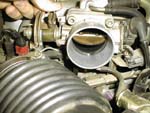 When I had everything out I looked at the throttle body. Inside it was coated with tar (as you can see in the picture). I am planning to clean this out in the near future.
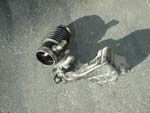 Now that the intake pipe and the resonator are out, use a 10mm socket to remove the resonator from the pipe.
The resulting 2.25" hole must be filled. I went to the local hardware store and found...
 ... a PVC end cap. This end cap has an inner diameter of 1.5" and an outer diameter of 2 3/16". I put it in the hole with the round side facing towards the inside of the pipe and held it in place using the stock hose clamp. Because the "plug" is 1/16" too small, I tighetened the hose clamp as far as it would go to make sure I had a good seal.
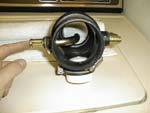 Here is a picture of the finished assembly. You can see the "plug" with the round side facing into the pipe. The curved metal tube inside the pipe is the crankcase breather.
Driving Impressions:
This modification seems to have made quite a difference. Previously, my car would seem rough at engine speeds above 3500 rpm. I had always assumed that this was due to internal friction in the engine, but with the resonator removed the engine is smooth all the way to redline. Consequentially, the car seems to rev a lot easier, and feels a little bit quicker. My theory is that the resonator was tuned to work with the stock air intake, with the cone filter it may have been creating some kind of dissonance in the airflow which was causing the roughness above 3500 rpm.
The trade off is an increase in volume. At idle and up to 3000 rpm the car doesn't seem much louder, and at higher rpms it has developed a throaty roar.
©1998 House Of Insanity Productions

 It occured to me the other day that I still had one intake resonator left on the car. This was the one that hangs down from the bottom of the pipe that connects the TB (throttle body) to the MAS (mass-air sensor). I started to wonder if I would get any power benefits if I removed it (good), and if it would make the car louder (bad). I figured that since I already have an aftermarket intake, comparitively, the volume increase wouldn't be too severe.
 When I had everything out I looked at the throttle body. Inside it was coated with tar (as you can see in the picture). I am planning to clean this out in the near future.
 Now that the intake pipe and the resonator are out, use a 10mm socket to remove the resonator from the pipe.
 ... a PVC end cap. This end cap has an inner diameter of 1.5" and an outer diameter of 2 3/16". I put it in the hole with the round side facing towards the inside of the pipe and held it in place using the stock hose clamp. Because the "plug" is 1/16" too small, I tighetened the hose clamp as far as it would go to make sure I had a good seal.
 Here is a picture of the finished assembly. You can see the "plug" with the round side facing into the pipe. The curved metal tube inside the pipe is the crankcase breather.